// Foundations
What is transhumanism?
A philosophical and technological movement with a clear goal: to use science and technology to fundamentally improve human existence physically, cognitively, and emotionally. Here are the foundations: the history, the ideas, the players, and the criticism you need to know.
01
The core idea: humans are not the terminus
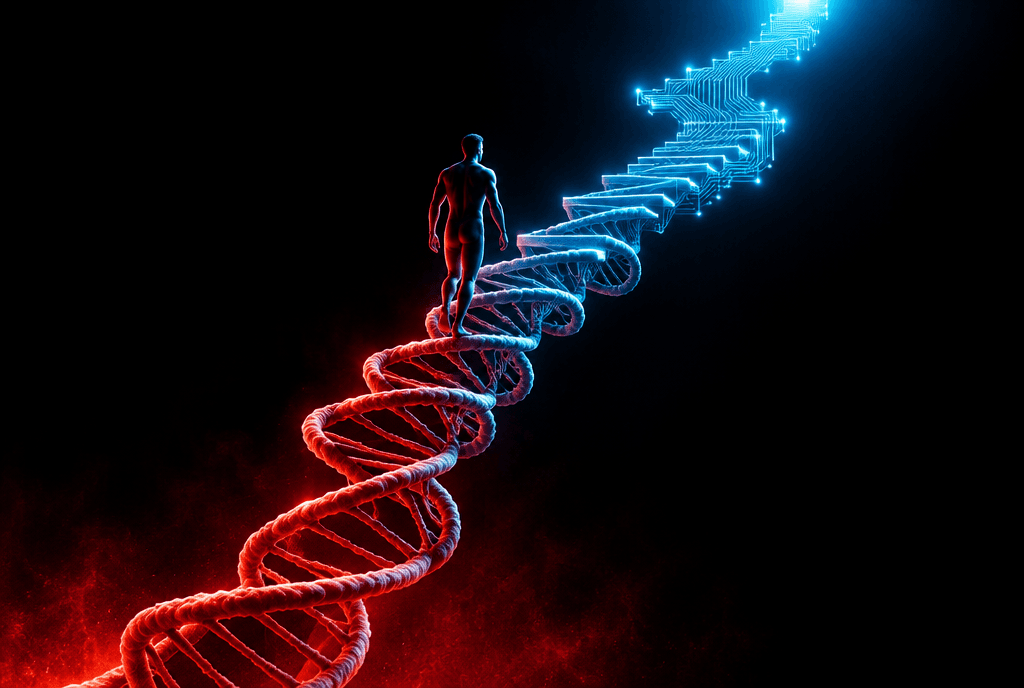
Transhumanism sees today's human not as the endpoint of evolution but as a transitional stage. Disease, aging, and the limits of our brains are not laws of nature to be humbly accepted, but engineering problems, solvable through genetics, neurotechnology, artificial intelligence, and medicine. That sounds radical, but it follows a simple observation: we correct eyesight with glasses, replace heart valves, transplant organs. The question is not whether we intervene in biology, but how far.
The term was coined in 1957 by, of all people, a biologist: Julian Huxley, the first director-general of UNESCO, described 'transhumanism' as the belief that humanity can transcend itself. In the 1970s and 80s, the Iranian-American futurist FM-2030 turned it into a way of life, and in 1990 the philosopher Max More formulated the first systematic transhumanist philosophy: humans should continue their own evolution rationally, scientifically, and self-determined.
In 1998, philosophers Nick Bostrom and David Pearce founded the World Transhumanist Association, today's Humanity+, which gave the movement an academic foundation. Since then, a handful of pioneers has grown into a worldwide network of researchers, entrepreneurs and activists. What unites them: the conviction that the human condition can be improved, and that doing nothing is also a decision, just a bad one.
02
The three pillars: super-longevity, super-intelligence, super-wellbeing
The movement pursues three great lines. First, super-longevity: radically extending the healthy lifespan. Aging is understood as a cascading maintenance backlog of damaged cells, shortened telomeres and clumped proteins, and each of these processes is treatable in principle. The long-term goal is called longevity escape velocity: the point where research gains more than a year of life per year that passes.
Second, super-intelligence: expanding our cognitive abilities. In the short term this happens through AI tools that already amplify our thinking, writing and research today. In the medium term it happens through brain-computer interfaces that remove the detour via keyboard and screen, and in the long term through a true coupling of biological brain and machine intelligence. The bandwidth between mind and computer is growing measurably year after year.
Third, super-wellbeing: improving our emotional baseline. This ranges from more precise treatment of mental illness and neurofeedback to the philosophical question of whether suffering as a biological default state is defensible at all. Each of these three pillars has real research programs, real budgets and real clinical trials today. None of it is pure theory anymore.
03
From mailing list to billion-dollar industry
What was a niche mailing list in the 1990s is an industry today. Jeff Bezos invested in Altos Labs, which aims to reverse aging through cellular reprogramming. Google founded Calico for the same purpose, and Sam Altman finances Retro Biosciences. Elon Musk founded Neuralink with the declared mission of enabling symbiosis between humans and AI. The days when transhumanism was a ridiculed hobby are over.
Governments joined long ago: the US funds brain research with billions through the BRAIN Initiative, the EU did so with the Human Brain Project, and China has declared neurotechnology a strategic priority. Chile became the first country in the world to write 'neurorights' into its constitution. When governments regulate and invest, a technology has outgrown its niche.
For you, that means: the question is no longer whether these technologies arrive. They are here, or in clinical trials. The real question is who shapes them, who owns them, and who gets access. That is exactly why this platform exists: so the debate is not held only in boardrooms and labs, but in public.
04
The hard questions and the best criticism
An honest transhumanism does not dodge criticism but seeks it out. The most famous critique comes from political scientist Francis Fukuyama, who declared transhumanism 'the world's most dangerous idea': if we technically alter human nature, he argues, we undermine the basis of equal rights. Jürgen Habermas similarly warned of a 'liberal eugenics' in which parents and markets decide the biological makeup of future people.
Then come the distribution questions: will the upgrade be available to everyone or only the rich? Does a biological two-class society emerge? What happens to identity and autonomy when thoughts become readable and influenceable? And where does therapy end and enhancement begin? Does health insurance pay for the memory implant against dementia, but not for the healthy student?
These questions have no easy answers, and anyone promising some is selling something. Our position: the risks are real, but they are an argument for public debate, open standards and fair access rules, not for a ban that only pushes development into opaque channels. Where I personally stand, you can read in the manifesto.