// Hardware of evolution
Technologies & Neuralink
From brain chips to bionic hands: the key technologies actually shifting the boundary between body and machine. Here is what already works today, what is in trials, and what comes next.
01
Neuralink: the most famous brain chip
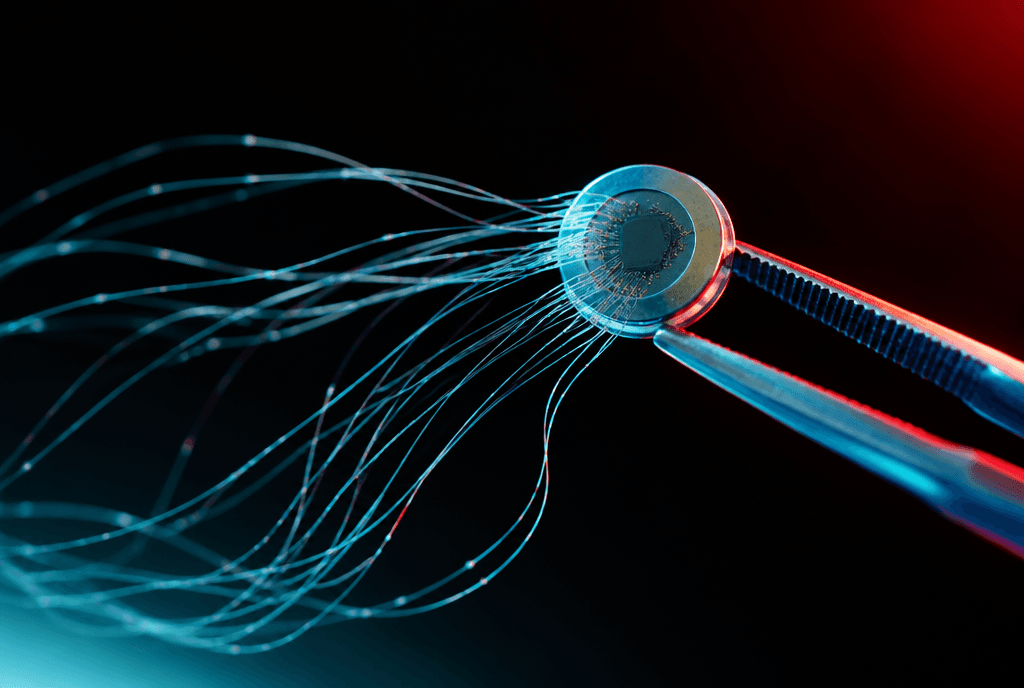
In January 2024, Neuralink implanted its N1 chip in a human for the first time: over 1,000 electrodes on flexible threads, each thinner than a human hair, placed by a purpose-built surgical robot called R1, more precisely than any human surgeon could. The chip reads the activity of individual neurons in the motor cortex and transmits it wirelessly to a computer. From the outside, nothing is visible.
The first patient, Noland Arbaugh, has been paralyzed from the neck down since a swimming accident. With the implant he plays chess and strategy games, browses the web, and describes his regained independence as life-changing. By now, more than a dozen people carry the chip. They move cursors, write messages and work again with thought alone. Incidents like the temporarily retracted electrode threads in the first patient also show how young the technology is.
The next step is called Blindsight: an implant in the visual cortex meant to give blind people a coarse field of vision, already designated a 'Breakthrough Device' by the FDA. Long term, Neuralink speaks openly about its actual founding goal: a bandwidth expansion of the brain for healthy people, the symbiosis of human and AI.
02
The wider field: Synchron, speech decoding & co
Neuralink is the loudest, but not the only serious player. Synchron from New York reaches the brain without opening the skull at all: the 'Stentrode' is threaded like a heart stent through the jugular vein into a blood vessel on the motor cortex. Signal quality is lower than with implanted threads, but the procedure is routine surgery, and patients have already used it to control smartphones and even an Apple Vision Pro.
In parallel, speech decoding is exploding: research teams at Stanford and San Francisco translate the brain activity of people who lost their speech to ALS or stroke into text and synthetic voices, now at nearly 80 words per minute, close to the pace of natural conversation. What was considered decades away five years ago is running in clinical trials today.
At the low end of invasiveness are consumer EEG headsets: they only read coarse signals through the skull, but work for neurofeedback, meditation and simple control. The direction of the entire field is unambiguous: more channels, less risk, smaller devices. The bandwidth between brain and computer grows year after year.
03
Cyborgs already exist: millions live with technology inside
The first pacemaker was implanted in 1958, and today millions of people worldwide live with one. Over a million deaf people hear through cochlear implants that translate sound directly into nerve signals. Well over a hundred thousand Parkinson's patients carry deep-brain-stimulation electrodes in their skulls that stop their tremors at the push of a button. Nobody calls any of this science fiction. It is standard medicine.
I am one of them: an artificial heart valve works inside my chest. That experience changed my view of this entire debate: once you carry technology in your body, the discussion about the 'naturalness' of the human being stops being theoretical. The cyborg is not a figure of the future. They are sitting next to you on the subway, and sometimes they are writing the website you are reading right now.
What is new is only the direction: bionic prostheses now return a sense of touch, retina implants first visual impressions, exoskeletons let paraplegics walk again. We are visibly moving from repairing to enhancing, and the same technologies that compensate deficits today will redefine the standard tomorrow.
04
Longevity & biohacking: the assault on aging
Parallel to the hardware, work on biology itself is accelerating. In 2023, Casgevy became the world's first approved CRISPR gene therapy. It cures sickle cell disease by precisely rewriting DNA. What begins as a tool against rare hereditary diseases is, in principle, an editor for the human blueprint, and the ethics debate about that has only just begun.
Longevity research attacks aging directly: cellular reprogramming can return aged cells to a younger state, and companies like Altos Labs work on this with billion-dollar budgets. Senolytics clear out senescent 'zombie cells' that drive inflammation. Caloric restriction, rapamycin and metformin reliably extend life in animal studies. Whether that transfers to humans is the billion-dollar question.
The declared long-term goal of the field is longevity escape velocity: the point where medical progress gains more than one year of healthy life per year. Whether we reach it in twenty years or never, the mere possibility changes how one has to think about health, retirement and life planning. We document the state of research, not the promises of salespeople.
// Easter egg
The Ripperdoc Catalog
You know the cyberware from Night City? Here's what actually exists in 2026, with status straight from the clinic and the trial registry.
| Street name | Real technology | Status | Availability |
|---|---|---|---|
| Kiroshi optics | Blindsight (Neuralink): vision prosthesis for the visual cortex | FDA Breakthrough Device, preclinical | Waitlist: being blind |
| Neural port | N1 implant (Neuralink): 1,024 electrodes | Clinical trials, 12+ users | Severe paralysis, trial slot |
| Vessel jack | Stentrode (Synchron): BCI via the bloodstream | Clinical trials US/AUS | ALS/paralysis, trial slot |
| Subdermal audio | Cochlear implant | Approved, covered by insurance | At your trusted ENT |
| Tremor damper | Deep brain stimulation (DBS) | Approved for decades | Parkinson's indication |
| Gorilla arm | Bionic prosthesis with a sense of touch | Approved / ongoing trials | After amputation |
| Sandevistan | (reflex boosters don't exist) | Pure fiction | Come back in 30 years, choom |
Not an actual ripperdoc. We don't install chrome and won't answer requests to. We only document what medicine can really do.