Ghost in the Shell: Who Owns Your Body Once It's Replaceable?
Full prosthetic bodies, cyberbrain hacking and the question of the "ghost": what the 1995 anime classic knew about identity, and how much of it neurotechnology delivers in 2026.
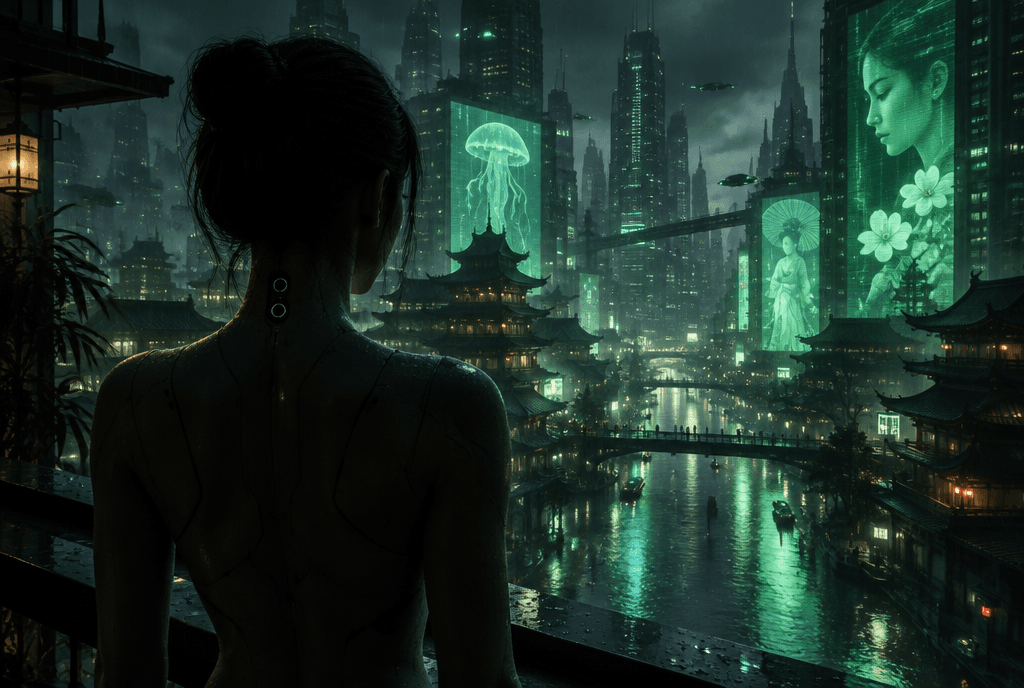
Thirty years before Neuralink implanted its first human, Major Motoko Kusanagi sat on a rooftop and asked the question neuroethics is still wrestling with: if my body is fully artificial and my memories can be copied, what exactly is still me?
The "ghost": substrate independence as anime
Ghost in the Shell (1995) calls consciousness the "ghost" and the body the "shell", and it separates the two radically. The philosophy behind it is known today as substrate independence: the thesis that consciousness depends on the organization of information processing, not on the biological carrier material. Whether it's true is perhaps the biggest open question in the philosophy of mind, and the film treats it not as an answer but as a wound. Kusanagi doesn't know whether her ghost is real. Exactly that uncertainty makes the film more honest than most contributions to today's debate.
Full prosthetic bodies: closer than the Sandevistan, further than the hype
Kusanagi's body is entirely artificial. In reality we are far from that, but the direction matches: bionic arms with a sense of touch, leg prostheses people run marathons on, artificial heart valves and retinal implants. The decisive difference from the film: real prosthetics replace lost function and almost never surpass biology. The transition from repairing to enhancing is the actual tipping point, and on the timeline it still lies ahead of us.
Cyberbrain hacking: the film's best warning
In the film, people with hacked cyberbrains become puppets with false memories. That's not paranoia. It's IT security thought through to the end: the moment the brain has an interface, it is an attack surface. This is exactly why neurorights, covering mental privacy, protection of identity, and protection from manipulation, are not an academic footnote but the legislative task of the coming decade. Chile was the first country to write them into its constitution. The film described the problem completely in 1995.
The Puppet Master is not an AI that wants to destroy humans. It's one that wants to live. That is the more interesting threat.
What Ghost in the Shell does better than almost every successor
The film offers neither all-clear nor panic. It takes the merge as given and asks what it does to identity, memory and responsibility. That is exactly the stance of this hub: the technology is coming. The question is who writes the rules. If you watch only one film from our library, make it this one.
And if you then want to know how close reality already is: the Implant Watch tracker is counting.
- Ghost in the Shell
- Culture
- Identity
// Keep reading